
Table of Contents
ToggleIntroduction
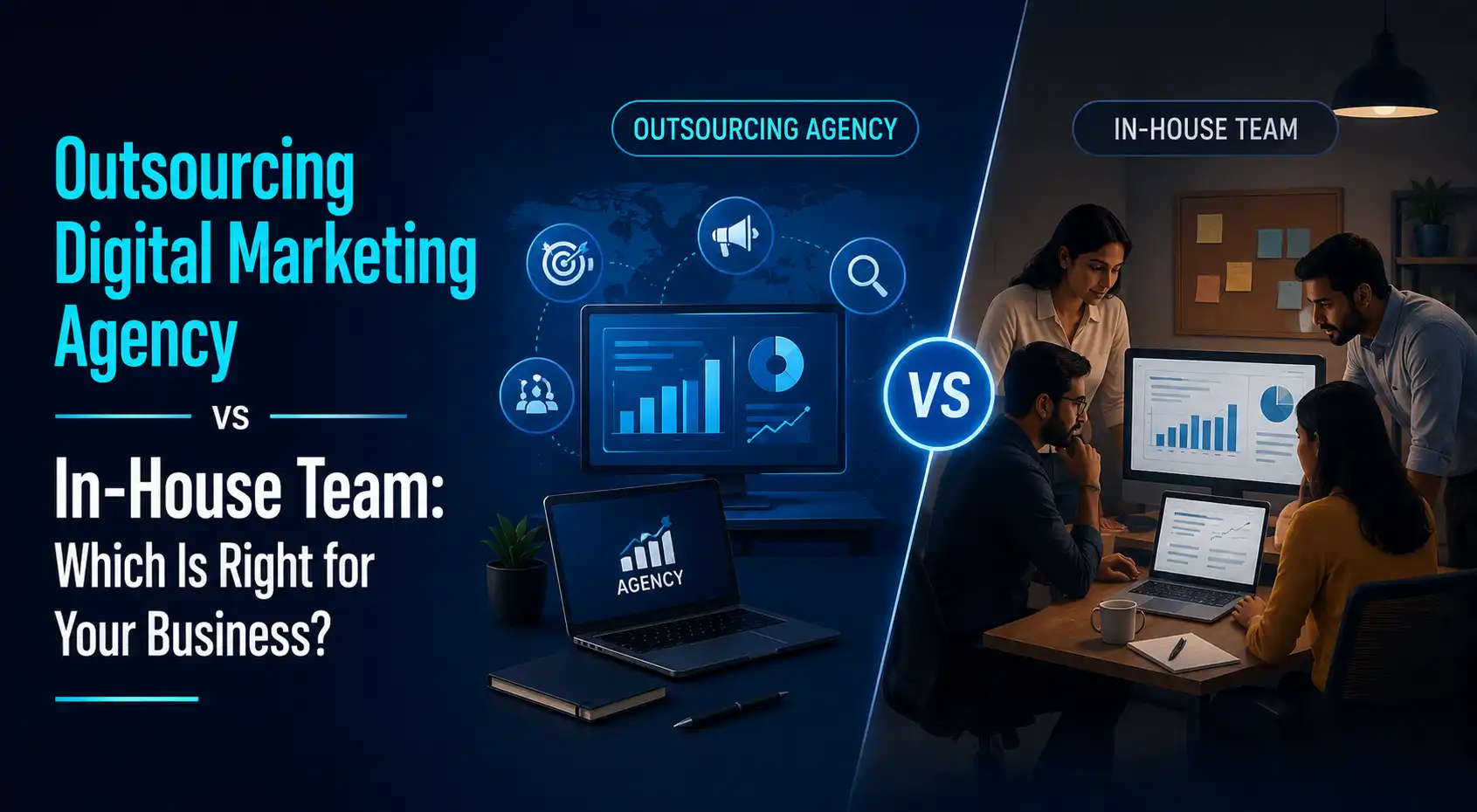
As digital marketing becomes a crucial driver of business growth, businesses must make an important decision: should they build an in-house team or work with an outsourcing digital marketing agency? Both approaches have advantages, problems, and financial repercussions. The best option is determined by your business’s goals, budget, internal resources, and overall digital marketing strategy.
Some firms choose an internal team since it allows them more direct control and a deeper grasp of the brand. Others prefer to outsource because agencies offer specialized experience, innovative tools, and scalable assistance without the administrative costs associated with recruiting full-time staff.
In reality, there is no one-size-fits-all solution. A startup with low resources can profit substantially from outsourcing, whereas a huge corporation may require dedicated inside marketing personnel. Understanding the advantages and disadvantages of both models will help you make better business decisions and maximize your marketing spend.
What Is a Digital Marketing Agency vs an In-House Team?
A digital marketing agency is an external partner that provides specialized marketing services such as SEO, social media management, paid advertising, content marketing, branding, website development, and performance marketing. Businesses outsource these services to gain access to experienced professionals, advanced tools, and proven strategies without the cost of building a full internal department.
An in-house marketing team, on the other hand, consists of employees who work directly within the organization and focus exclusively on the company’s marketing activities. They have a deeper understanding of the brand, products, services, and company culture, which helps maintain consistency in communication and decision-making.
Both approaches can support business growth, but they differ significantly in terms of cost, expertise, scalability, and operational flexibility. While agencies provide access to a diverse team of specialists and industry-wide experience, in-house teams offer greater control and direct collaboration. The ideal choice depends on factors such as business size, budget, marketing goals, and long-term digital marketing strategy. Understanding the strengths and limitations of each model helps businesses choose the most effective approach for achieving sustainable growth and better marketing results.
What Does a Digital Marketing Agency Offer?
A digital marketing agency is an external partner that offers marketing services to organizations. SEO, social media marketing, paid advertising, content production, branding, website construction, video marketing, analytics, and automation are common specializations within agencies.
Instead of employing different individuals separately, organizations may access a full team of experts. Agencies work across multiple industries and campaigns, gaining wide industry experience and exposure to the most recent trends.
Most agencies also invest in premium marketing tools, advanced reporting systems, creative resources, and campaign optimization technologies. This enables firms to harness knowledge without incurring the entire cost of establishing an internal department.
A good agency does more than just execute duties; it creates strategy, evaluates performance, and continuously optimizes campaigns to meet company objectives.
What Is an In-House Digital Marketing Team?
An in-house team consists of marketing specialists who work directly for the organization. These individuals focus solely on the company’s marketing activities and are heavily involved in everyday operations.
In-house teams may comprise content writers, SEO professionals, social media managers, designers, performance marketers, and marketing managers. Depending on the size of the organization, various functions may be consolidated or increased.
Because they work internally, in-house teams frequently gain a better understanding of company culture, products, services, customers, and brand voice. They can work directly with sales teams, management, and other departments without the communication barriers that may occur with external partners.
However, developing a professional internal team necessitates substantial expenditure in recruitment, compensation, software, training, and management.
In-House Marketing Team Pros
- Strong understanding of the company’s products, services, and culture.
- Faster communication and collaboration with internal departments.
- Greater control over campaigns, priorities, and brand messaging.
- Immediate access to team members for quick decision-making.
- Better alignment with long-term business objectives and company vision.
In-House Marketing Team Cons
- Higher costs due to salaries, benefits, training, and software subscriptions.
- Difficult and expensive to hire specialists for every marketing function.
- Limited exposure to industry-wide trends and cross-sector experience.
- Scaling the team requires additional recruitment and onboarding efforts.
- Employee turnover can disrupt marketing performance and continuity.
Real Cost Comparison — Agency vs In-House in India
Cost is one of the biggest factors influencing the decision between outsourcing and hiring internally.
True Cost of Building an In-House Team in India
Many businesses underestimate how expensive it is to build a capable marketing department. Hiring one marketing professional is relatively simple, but creating a complete team with diverse expertise can become costly.
A typical digital marketing team may require:
- SEO Specialist
- Social Media Manager
- Content Writer
- Graphic Designer
- Performance Marketing Expert
- Marketing Manager
Beyond salaries, businesses must also cover employee benefits, recruitment expenses, office infrastructure, training costs, software subscriptions, hardware, internet, and operational overhead. As digital marketing evolves rapidly, companies must continuously invest in upskilling employees. New advertising platforms, algorithm changes, AI tools, and analytics systems require ongoing learning. Employee turnover can also create hidden expenses. Replacing experienced marketers often involves recruitment costs and productivity loss during onboarding.
Cost of Outsourcing to a Digital Marketing Agency in India
Working with an outsourcing digital marketing agency usually entails a monthly retainer, project fee, or performance-based agreement. Instead of hiring numerous personnel, organizations can leverage a team that already comprises marketing expertise. Agencies share operational costs with several clients, making expertise more affordable. Businesses also save money on software subscriptions, training programs, equipment, recruiting, and internal management.
These responsibilities are handled independently by the agencies. Outsourcing allows many startups and developing businesses to gain access to better levels of expertise while investing less overall.
Hidden Costs Most Businesses Overlook
When comparing costs, many businesses focus only on salaries or agency fees while ignoring hidden expenses. For in-house teams, hidden costs include:
- Recruitment fees
- Employee benefits
- Training and development
- Paid software subscriptions
- Team management
- Employee turnover
- Productivity gaps
For agencies, hidden costs may include:
- Onboarding time
- Communication processes
- Scope expansion charges
- Delayed approvals affecting campaign timelines
Evaluating these hidden factors helps create a more accurate comparison between both options.
Cost and Budget Comparison — Digital Marketing Agency vs In-House Team
Budget flexibility often determines which model is more practical. An in-house structure involves fixed monthly costs regardless of workload or campaign activity. Employees must be paid consistently even during slow business periods.
An agency provides greater flexibility. Businesses can increase or decrease service levels based on marketing objectives and seasonal demand. For startups and small businesses, this flexibility can be particularly valuable. Marketing budgets can be adjusted without restructuring internal teams or making hiring decisions. However, larger organizations with consistent marketing requirements may find long-term value in maintaining internal teams because resources are utilized continuously. The best approach depends on how predictable your marketing needs are and how quickly your business expects to scale.
Expertise and Skill Set
Today’s digital marketing necessitates a multidisciplinary approach.
SEO, paid advertising, analytics, automation, content marketing, email campaigns, social media management, video production, branding, conversion optimization, and AI-powered technologies all necessitate specific understanding. Creating an internal team with expertise in all areas is difficult and costly. Most businesses hire generalists or have smaller teams with limited specialization.
Agencies, on the other hand, hire individuals who specialize in specific fields. Their cross-industry knowledge provides them with a broader perspective on market trends and best practices. Because agencies work on a variety of campaigns, they can identify winning tactics more quickly and respond to changing market conditions. An in-house team may have a thorough understanding of the business, but agencies typically provide greater technical experience and an outside perspective.
Scalability and Flexibility
Business needs change frequently. Marketing requirements during a product launch are very different from those during regular operations. An agency can scale resources quickly by assigning additional specialists, increasing campaign budgets, or expanding into new channels without requiring new hires. This flexibility allows businesses to respond rapidly to opportunities and market changes. In-house teams are generally less flexible. Scaling requires recruitment, onboarding, training, and management, which can take weeks or months.
For businesses experiencing rapid growth, agencies often provide the agility needed to maintain momentum. Scalability becomes especially important when entering new markets, launching products, or handling seasonal demand spikes.
Control and Communication
Control is often the strongest argument for maintaining an internal team.
Employees work within the company, attend meetings regularly, and have direct access to leadership. This creates faster communication and greater alignment with business objectives. Internal teams can respond immediately to changes and collaborate more closely with sales, operations, and product departments.
Agencies require structured communication systems. While professional agencies provide account managers and reporting processes, communication still depends on established workflows. Businesses that require constant collaboration and real-time decision-making may prefer an internal team. However, agencies with strong communication frameworks can still deliver excellent responsiveness and transparency.
Digital Marketing Agency Pros
- Access to a team of specialists across SEO, PPC, social media, content, and design.
- More cost-effective than hiring multiple full-time marketing professionals.
- Easily scalable based on business growth and campaign requirements.
- Access to premium marketing tools, technologies, and industry insights.
- Brings fresh perspectives and experience from working across multiple industries.
Digital Marketing Agency Cons
- May require time to fully understand your brand and business goals.
- Less day-to-day control compared to an internal team.
- Communication may depend on scheduled meetings and reporting structures.
- Quality can vary depending on the agency’s expertise and processes.
- Businesses may become dependent on external partners for execution.
In-House Marketing Team Pros
- Strong understanding of the company’s products, services, and culture.
- Faster communication and collaboration with internal departments.
- Greater control over campaigns, priorities, and brand messaging.
- Immediate access to team members for quick decision-making.
- Better alignment with long-term business objectives and company vision.
In-House Marketing Team Cons
- Higher costs due to salaries, benefits, training, and software subscriptions.
- Difficult and expensive to hire specialists for every marketing function.
- Limited exposure to industry-wide trends and cross-sector experience.
- Scaling the team requires additional recruitment and onboarding efforts.
- Employee turnover can disrupt marketing performance and continuity.
Digital Marketing Agency vs In-House: Which Option Delivers Better ROI?
ROI depends on how effectively marketing resources are utilized. For many startups and growing businesses, agencies often deliver stronger ROI because they provide immediate access to expertise without the costs associated with hiring full-time employees.
Agencies also tend to optimize campaigns more aggressively because performance directly affects client retention. In-house teams may deliver stronger ROI for larger organizations with ongoing marketing requirements and complex internal operations.
The highest ROI often comes from aligning resources with business needs rather than choosing one model universally. Some companies even adopt hybrid models where strategic oversight remains internal while execution is outsourced.
Digital Marketing Agency vs In-House: What’s Right for You?
The right choice depends on your goals, budget, and growth stage. If your business needs rapid growth, specialized expertise, and flexibility, an outsourcing digital marketing agency may be the better option.
If your organization values direct control, continuous collaboration, and deep brand integration, an in-house team may be more suitable. Businesses should consider factors such as budget, marketing complexity, scalability requirements, communication preferences, and long-term objectives before making a decision. There is no universally correct answer—only the solution that aligns best with your business model.
Conclusion
Choosing between an outsourcing digital marketing agency and an in-house team is a strategic business decision that affects growth, efficiency, and marketing performance.
Agencies offer expertise, scalability, flexibility, and access to specialized resources. In-house teams provide direct control, stronger brand understanding, and closer collaboration. Rather than focusing solely on cost, businesses should evaluate which option supports their long-term digital marketing strategy, operational structure, and growth goals. For many businesses, the ideal solution may even be a hybrid approach that combines the strengths of both models.
Ultimately, success depends not on whether marketing is outsourced or managed internally, but on how effectively the chosen model is aligned with business objectives.
FAQs
A digital marketing agency is an external partner that provides specialized marketing services, while an in-house team consists of employees working directly within the company.
For many startups and growing businesses, agencies are often more cost-effective because they provide access to multiple specialists without full-time hiring costs.
They can, especially when businesses need specialized expertise, scalability, and performance-driven execution.
Greater control, stronger brand understanding, direct communication, and closer collaboration with internal departments.
Startups often benefit from outsourcing when they need expertise, flexibility, and cost-efficient growth support.
Potential risks include communication challenges, dependency on external teams, and varying service quality if expectations are unclear.
It depends on business goals, budget, growth stage, and operational requirements. Both models can be highly effective when implemented correctly.