

Table of Contents
ToggleCategory
- Blog
- Branding
- Digital Marketing
- Graphic Design
- Nictiontech
- Real Estate
- Social Media Marketing
- Video Marketing
- Video Production
- Website Design
Recent Posts
- B2B Content Marketing Trends for 2026: What Decision-Makers Must Prepare For
- How Hoarding Design for Real Estate Generates Offline Leads
- Why Performance Marketing Is Dominating India’s Digital Landscape
- Best Website Design Company in Vadodara for Small Businesses
- Why SEO Is Still the Highest ROI Digital Marketing Channel
Generating traffic is easy today, but converting that traffic into meaningful leads and customers remains a major challenge for businesses. Brands invest heavily in digital ads, content marketing, and social platforms, yet most visitors leave without taking action. This is where Performance Marketing Funnels play a crucial role. These funnels create a structured, data-backed journey that guides users from first interaction to final conversion, ensuring that marketing efforts deliver measurable results.
In a competitive digital ecosystem, users expect relevance and timely communication. Random campaigns fail to nurture intent properly. A well-designed Performance Marketing Funnels approach ensures that every touchpoint moves prospects closer to a decision.
What Are Performance Marketing Funnels?
Definition of Performance Marketing Funnels
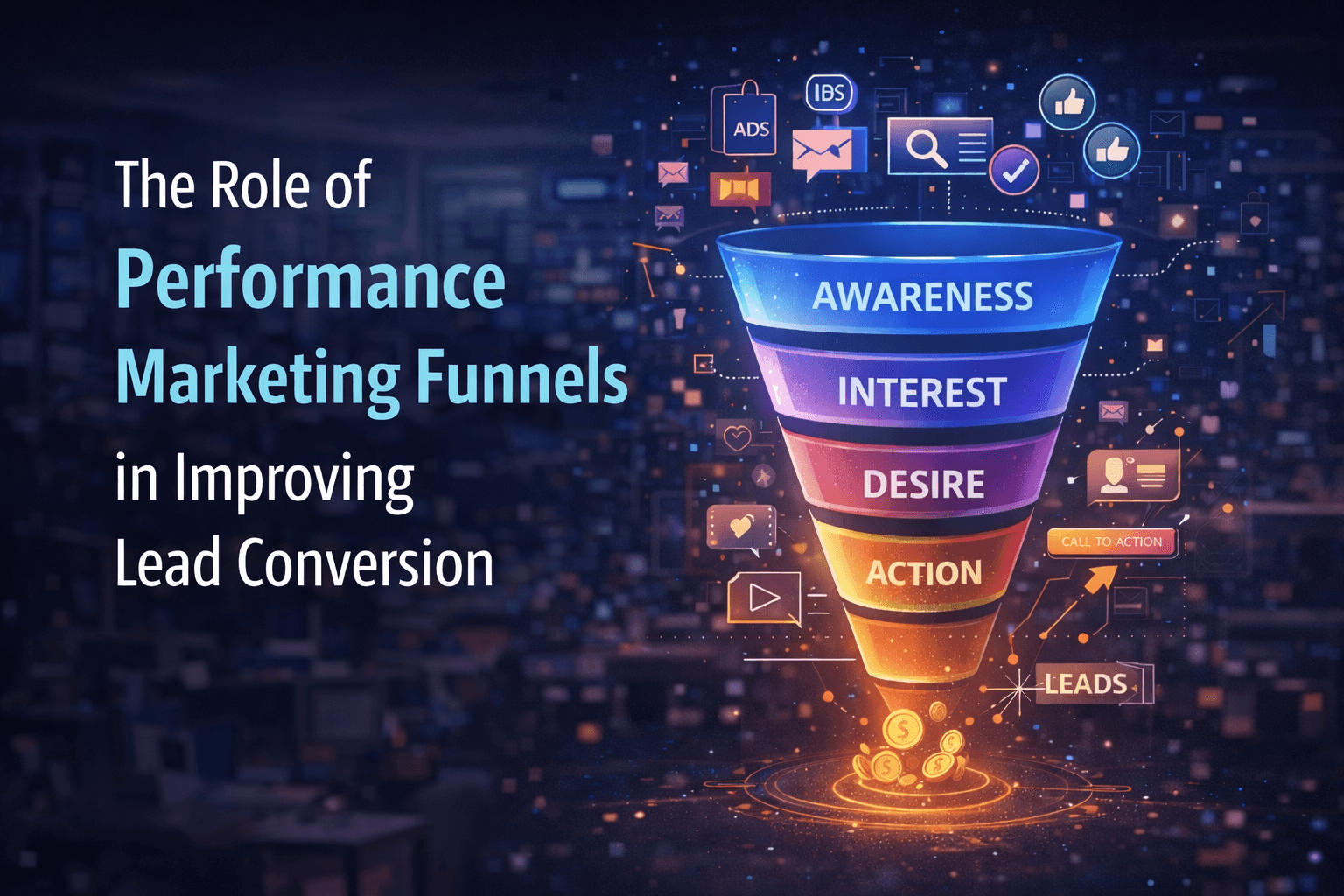
Performance Marketing Funnels are goal-oriented frameworks that guide users through different stages of the buying journey using performance data. Each stage focuses on a specific action such as awareness, engagement, or conversion. Instead of focusing on visibility alone, these funnels are built around outcomes like lead submissions, purchases, or inquiries.
By tracking behavior and intent signals, businesses can optimize messaging and offers at every stage to improve overall efficiency.
How Performance Funnels Differ from Traditional Marketing Funnels
Traditional funnels often apply the same message to every user, assuming that prospects will move forward naturally. Performance-focused funnels adapt dynamically based on user actions. Messaging, offers, and timing change depending on intent signals, engagement levels, and previous interactions. This adaptive approach results in higher relevance and stronger conversion potential.
Why Performance Marketing Funnels Are Critical for Lead Conversion
The Real Problem – Leads Without Intent
Many businesses generate a high volume of leads that never convert because those users are not ready to buy. Without proper qualification and nurturing, marketing efforts attract curiosity rather than intent. This leads to wasted budgets and low return on investment.
How Funnels Improve Lead Quality
Funnels filter users based on behavior and interest levels. Instead of treating every visitor equally, they identify high-intent prospects and nurture them with relevant content. This structured approach ensures that sales teams engage with better-qualified leads, improving close rates and efficiency.
Benefits of a Funnel-Based Performance Marketing Strategy
A funnel-driven Performance marketing strategy allows businesses to measure every step of the user journey. It improves targeting accuracy, reduces cost per lead, and creates predictable conversion paths. Over time, continuous optimization helps brands scale campaigns without increasing inefficiencies.
Core Stages of a High-Converting Performance Marketing Funnel
Awareness Stage: Capturing the Right Audience
The awareness stage focuses on attracting users who match the ideal customer profile. Paid ads, search campaigns, and social content introduce the brand to users actively searching for related solutions. Accurate targeting at this stage ensures the funnel starts with relevant traffic rather than random visitors.
Consideration Stage: Building Trust & Relevance
At this stage, users evaluate options. Educational content, re-marketing campaigns, and trust-building messages help brands stay top-of-mind. The goal is to address objections, provide value, and position the brand as a credible solution.
Conversion Stage: Turning Leads into Customers
When users reach the conversion stage, clarity and simplicity become critical. Optimized landing pages, strong calls-to-action, and friction less experiences help users take the final step. This stage directly impacts revenue and overall funnel success.
Retention & Up-sell Stage
Post-conversion engagement is often overlooked but plays a vital role in long-term growth. Retention campaigns, personalized follow-ups, and up-sell strategies increase customer lifetime value and strengthen brand loyalty.
How Lead Generation Funnels Improve Conversion Rates
Personalized User Journeys
Lead generation funnels create customized experiences based on user behavior. Visitors who engage with specific content receive tailored follow-ups that match their interests. This relevance increases engagement and significantly improves conversion rates.
Behavioral Tracking & Funnel Optimization
Tracking user behavior across platforms helps identify drop-off points and improvement areas. Continuous optimization ensures that each stage of the funnel performs better over time, resulting in higher efficiency and lower acquisition costs.
Role of Automation in Lead Generation Funnels
Automation tools play a key role in scaling funnels. They enable timely follow-ups, behavioral triggers, and personalized messaging without manual effort, ensuring consistency and speed across campaigns.
How to Build a Performance Marketing Funnel Step-by-Step
Step 1: Define Clear Funnel Goals
Every funnel must start with a clearly defined objective. Whether the goal is lead acquisition, sales, or retention, clarity ensures alignment across campaigns and channels.
Step 2: Choose the Right Performance Channels
Channel selection should be based on audience behavior and intent. Search, social, and remarketing platforms must work together to support different funnel stages.
Step 3: Create Funnel-Specific Landing Pages
Dedicated landing pages designed for specific funnel stages outperform generic pages. They focus on one objective: reducing distractions and improving conversion rates.
Step 4: Implement Tracking & Analytics
Accurate tracking provides insights into user journeys and conversion paths. Analytics enable data-driven decisions and continuous funnel optimization.
Step 5: Optimize & Scale What Works
Once high-performing elements are identified, scaling becomes easier. Ongoing testing and refinement ensure sustainable growth and improved ROI.
Common Funnel Mistakes That Hurt Lead Conversion
Sending All Traffic to One Generic Page
Generic pages fail to address different intent levels, leading to higher bounce rates and lower conversions.
Ignoring Middle-of-Funnel Nurturing
Skipping the consideration phase leaves users unprepared to convert, reducing overall funnel effectiveness.
No Follow-Up or Retargeting Strategy
Without follow-ups, interested users are lost. Retargeting helps re-engage prospects and improve conversion chances.
Measuring Clicks Instead of Conversions
Clicks do not reflect business impact. Conversion-focused metrics provide meaningful performance insights.
When Should Businesses Use Performance Marketing Funnels?
Startups vs Established Brands
Startups use funnels to validate demand efficiently, while established brands rely on them to scale and optimize marketing spend.
B2B vs B2C Funnel Strategies
B2B funnels focus on longer decision cycles and trust-building, whereas B2C funnels prioritize speed and emotional engagement.
Service-Based vs Product-Based Funnels
Service funnels emphasize credibility and consultation, while product funnels focus on benefits, pricing clarity, and urgency.
Future of Performance Marketing Funnels
AI-Driven Funnel Optimization
Artificial intelligence enables real-time personalization and smarter decision-making across funnel stages.
Predictive Lead Scoring
Advanced data models identify high-intent prospects early, allowing teams to prioritize effectively.
Privacy-First Tracking & First-Party Data
With increasing privacy regulations, first-party data will become the foundation of sustainable funnel strategies.
Cross-Channel Funnel Attribution
Future funnels will track user journeys across devices and platforms, providing a unified performance view.
Conclusion
A structured Performance marketing strategy combined with data-driven execution helps businesses convert intent into action. By implementing optimized Lead generation funnels, brands can improve lead quality, increase conversion rates, and achieve sustainable growth. In a results-driven digital world, funnel-based marketing is no longer optional—it is essential.
FAQs
A performance marketing funnel is a structured, data-driven system that guides potential customers through different stages of awareness, consideration, and conversion while focusing on measurable actions rather than vanity metrics.
They improve lead conversion by aligning messaging with user intent, tracking behavior across touchpoints, and optimizing each stage to reduce drop-offs and increase action-taking.
Search engines, social media advertising platforms, and remarketing networks work best when integrated properly and aligned with different stages of the funnel journey.
Initial insights can be seen within a few weeks, while consistent optimization usually delivers stronger and more stable results over a few months.
Key metrics include conversion rates, cost per lead, user drop-off points, lead quality, and customer lifetime value to measure overall funnel effectiveness.