
Table of Contents
ToggleCategory
- Blog
- Branding
- Digital Marketing
- Graphic Design
- Nictiontech
- Real Estate
- Social Media Marketing
- Video Marketing
- Video Production
- Website Design
Recent Posts
- 5 Hidden Metrics That Prove Your Ads Are Suffering from Creative Fatigue
- How Al Is Changing Digital Marketing Services in India
- Performance Marketing for Real Estate Property: Leads, Ads & ROI
- How to Get Your Brand Mentioned in ChatGPT and AI Search Results
- How Real Estate Brands Can Use Reels & Shorts to Sell Properties
Introduction
Businesses investing in digital advertising often face one common question: Google Ads vs Meta Ads-which platform delivers better ROI? Both platforms are among the most powerful digital advertising platforms, but they serve different purposes and audiences. While Google Ads targets users actively searching for products or services, Meta Ads helps businesses create demand through highly targeted social media campaigns. Understanding the strengths, costs, and return on investment of each platform is essential for making informed marketing decisions. This guide compares Google Ads ROI and Meta Ads ROI to help you choose the right advertising strategy for your business.
Understanding the Difference Between Google Ads and Meta Ads
What is Google Ads?
Google Ads is Google’s online advertising platform that allows businesses to display advertisements across Google’s ecosystem. These ads can appear on Google Search, YouTube, Gmail, Google Maps, partner websites, and mobile applications. Unlike traditional advertising, Google Ads primarily targets users who are already searching for products or services, making it an intent-driven advertising platform.
Google Ads offers several campaign types to meet different business objectives. Google Search Campaigns display text ads in search results based on keywords. YouTube Ads help businesses reach audiences through video content. The Google Display Network enables visual banner advertising across millions of websites and apps. Performance Max Campaigns use Al to optimize ads across all Google properties, while Google Shopping Ads showcase products with images and prices directly in search results. Google’s newer demand gen campaigns help businesses reach audiences across YouTube, Discover, and Gmail using visually engaging content.
What are Meta Ads?
Meta Ads are advertisements shown across Meta’s family of platforms, including Facebook, Instagram, Messenger, Audience Network, and newer Al-powered Advantage+ campaigns. Instead of targeting users based on search intent, Meta Ads focus on interests, behaviors, demographics, and online activity.
Businesses can use image ads, video ads, carousel ads, stories, reels, collection ads, and lead generation forms to reach highly specific audience segments. Meta’s machine learning capabilities continuously optimize campaigns to improve reach, engagement, and conversions. Because users are browsing social media rather than actively searching, Meta Ads excel at building brand awareness, generating demand, and nurturing potential customers throughout the buying journey.
What are intent-based advertising and interest-based advertising?
Intent-based advertising focuses on users who already have a specific need or purchase intention. Google Ads operates primarily on this model because users actively search using keywords like “buy running shoes” or “digital marketing agency near me.” Since these users already demonstrate intent, conversion rates are often higher.
Interest-based advertising targets users based on demographics, interests, online behavior, hobbies, previous interactions, and lifestyle preferences. Meta Ads use this approach to introduce products or services before users actively search for them. This strategy works particularly well for brand awareness, product discovery, and impulse purchases.
Google Ads vs Meta Ads Comparison
| Feature | Google Ads | Meta Ads |
|---|---|---|
| User Intent | High purchase intent through search queries | Interest and behavior-based targeting |
| Audience Targeting | Keywords, location, device, demographics, audience signals | Interests, demographics, lookalike audiences, behaviors |
| Ad Formats | Search Ads, Display Ads, Shopping Ads, Video Ads, Performance Max | Image Ads, Video Ads, Carousel, Stories, Reels, Collection Ads |
| Cost Per Click (CPC) | Generally higher due to keyword competition | Usually lower for most industries |
| Conversion Rate | Higher because users actively search | Moderate depending on audience targeting |
| Lead Quality | High-intent leads | Good quality when campaigns are optimized |
| Remarketing | Strong remarketing across Google Display Network and YouTube | Excellent remarketing through Facebook and Instagram |
| E-commerce | Excellent for high-intent shopping searches | Excellent for product discovery and retargeting |
| B2B Marketing | Highly effective due to search intent | Useful for awareness and remarketing campaigns |
| Local Businesses | Excellent through Google Search and Maps | Effective for local awareness and promotions |
Google Ads vs Meta Ads: Which Platform Delivers Better ROI?
The answer depends entirely on your business objectives.
If your goal is to generate immediate leads or sales from users actively searching for products or services, Google Ads often delivers a stronger return on investment. Businesses in industries such as healthcare, legal services, education, home improvement, SaaS, and B2B services typically experience higher Google Ads ROI because they capture customers with strong buying intent.
Meta Ads, however, deliver excellent ROI when businesses need to create demand, increase brand awareness, build communities, or promote visually appealing products. Fashion, beauty, fitness, lifestyle, food, hospitality, and D2C brands often achieve strong Meta Ads ROI because social platforms encourage product discovery and engagement.
Rather than choosing one platform over the other, many successful businesses combine both. Google Ads captures existing demand, while Meta Ads create future demand by introducing products to new audiences. This integrated strategy often produces higher overall ROI than relying on a single platform.
Google Ads vs Meta Ads Cost Comparison
| Metric | Google Ads | Meta Ads |
|---|---|---|
| Average Cost Per Click (CPC) | Sub-20-₹250+ (industry dependent) | ₹5-₹80+ |
| Average Cost Per Mille (CPM) | ₹150-₹700 | ₹80-₹500 |
| Average Cost Per Acquisition (CPA) | ₹300-₹5,000+ | ₹150-₹3,000+ |
| Average Click-Through Rate (CTR) | 3%-7% (Search Campaigns) | 1%-3% (varies by format) |
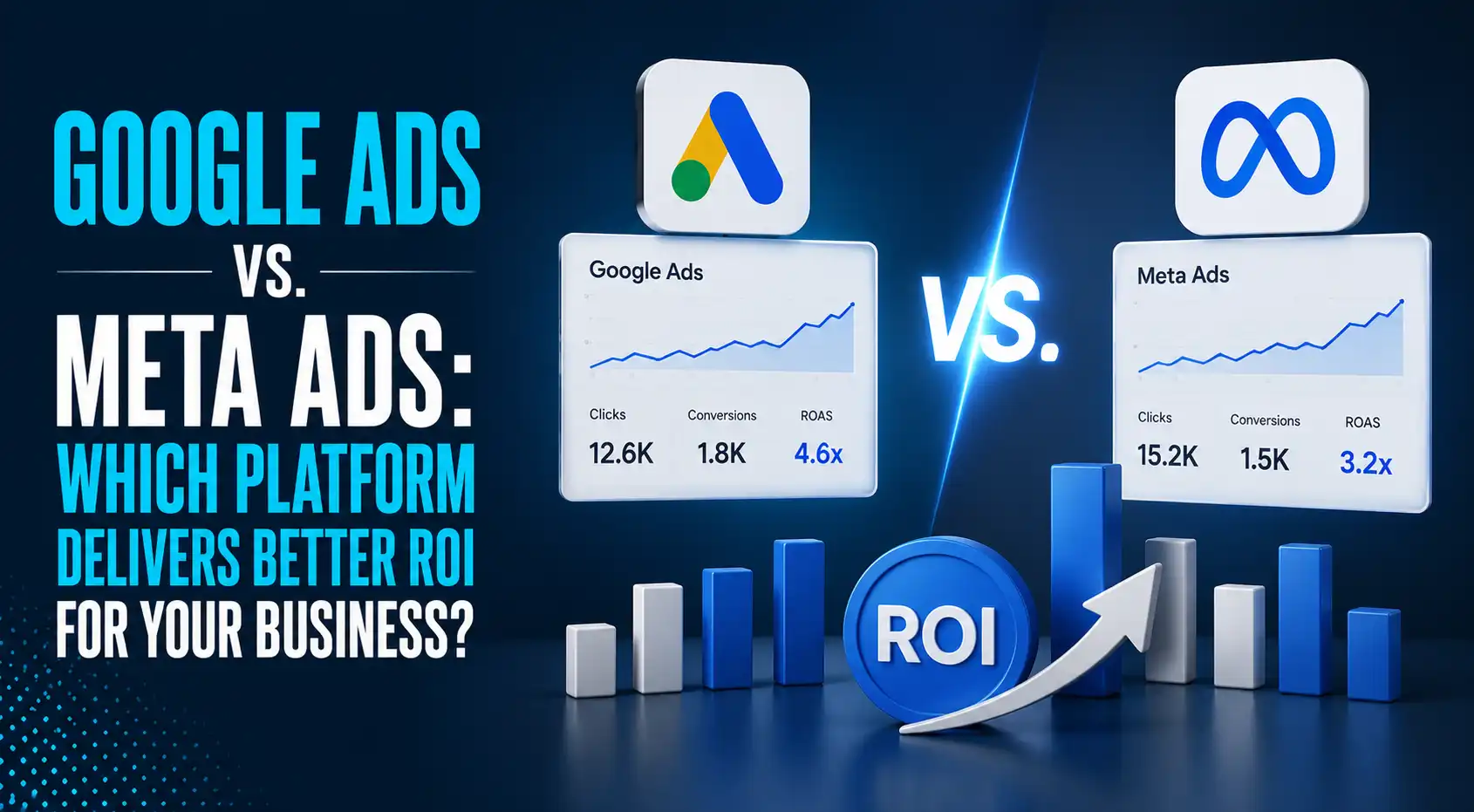
| Average Return on Ad Spend (ROAS) | 3:1 to 8:1 depending on optimization | 2:1 to 6:1 depending on audience targeting |
| Average CVR (Conversion Rate) | 3%-10% | 1%-5% |
These figures are general industry benchmarks and can vary depending on industry, competition, campaign quality, audience targeting, and landing page optimization.
Why Most Businesses Should Use Both Platforms
Many businesses approach paid advertising by choosing either Google Ads or Meta Ads. However, relying on only one platform can limit reach and growth opportunities. Since both platforms serve different purposes within the customer journey, combining them often produces better marketing performance and a higher overall return on investment.
Google Ads captures users who are actively searching for products or services. These users usually have strong purchase intent and are closer to making a buying decision. Meta Ads, on the other hand, help businesses create awareness among audiences who may not yet know about the brand. Through engaging visuals and precise audience targeting, Meta Ads generate interest and nurture potential customers before they begin searching.
Using both platforms creates a complete marketing funnel. Meta Ads introduce your brand and generate awareness at the top of the funnel, while Google Ads capture high-intent users who are ready to convert. Businesses can also use Meta Ads for remarketing campaigns while Google Ads target users through branded and non-branded search queries. This integrated approach increases brand visibility, improves customer touchpoints, and often results in stronger long-term ROI than using a single advertising platform.
Common Mistakes Businesses Make with Paid Ads
Even with advanced advertising platforms, many businesses fail to achieve their desired results because of avoidable mistakes. Understanding these common issues can significantly improve campaign performance and maximize advertising budgets.
Choosing the Wrong Advertising Platform
One of the biggest mistakes is selecting a platform without considering business objectives. Businesses looking for immediate purchase intent often benefit more from Google Ads, while brands focused on awareness and engagement may achieve better results through Meta Ads. Choosing the wrong platform can reduce campaign effectiveness and increase advertising costs.Poor Audience Targeting
Successful advertising depends on reaching the right audience. Broad targeting often leads to wasted ad spend, while overly narrow targeting can restrict campaign reach. Businesses should continuously refine audience segments based on demographics, interests, behaviors, locations, and previous customer interactions.Not Defining Clear Campaign Goals
Running campaigns without specific objectives makes it difficult to measure success. Whether the goal is lead generation, website traffic, sales, app installs, or brand awareness, every campaign should have clearly defined Key Performance Indicators (KPIs). Clear goals also help advertising algorithms optimize campaign delivery more effectively.Poor Ad Creatives
Even with accurate targeting, poorly designed advertisements often fail to generate engagement. Weak headlines, low-quality visuals, unclear messaging, and missing calls-to-action reduce click-through rates and overall campaign performance. High-quality creatives that address customer pain points typically produce stronger results.Weak Landing Pages
Many businesses focus heavily on ad optimization while neglecting the landing page experience. Slow loading speeds, confusing layouts, poor mobile responsiveness, and unclear conversion paths often result in high bounce rates and low conversion rates. A well-designed landing page should match the advertisement’s message and guide visitors toward taking action.No Conversion Tracking
Without conversion tracking, businesses cannot accurately measure campaign performance or understand which advertisements generate results. Setting up Google Ads Conversion Tracking, Meta Pixel, and analytics tools allows marketers to optimize campaigns using real performance data instead of assumptions.No Remarketing
Most users do not convert during their first interaction with a business. Remarketing campaigns allow businesses to reconnect with previous website visitors and potential customers who have already shown interest. Ignoring remarketing often results in missed sales opportunities and lower overall ROI.
Which advertising platform is more cost-effective: Meta Ads or Google Ads?
Cost-effectiveness depends on campaign objectives rather than advertising costs alone. Google Ads often has a higher average cost per click because advertisers compete for high-intent keywords. However, these clicks usually come from users actively searching for products or services, which can lead to higher conversion rates and stronger ROI.
Meta Ads generally offer lower cost per click and lower cost per mille, making them attractive for businesses focused on awareness, audience growth, and engagement. They are particularly effective for visually driven industries such as fashion, beauty, food, fitness, and lifestyle brands.
For service-based businesses, B2B companies, healthcare providers, educational institutions, and local businesses, Google Ads often produces higher-quality leads due to stronger purchase intent. For e-commerce businesses launching new products or building brand recognition, Meta Ads frequently provides a more cost-effective customer acquisition strategy.
Rather than comparing costs alone, businesses should evaluate cost-effectiveness based on lead quality, conversion rates, customer lifetime value, and return on ad spend.
Tracking Tools For Meta Ads & Google Ads
Measuring advertising performance accurately requires reliable tracking tools. These tools help businesses understand customer behavior, monitor conversions, and optimize campaigns for better ROI.
Google Analytics 4 (GA4)
Google Analytics 4 provides detailed insights into website traffic, user behavior, conversion paths, and engagement across multiple marketing channels. It helps businesses understand how visitors interact with their websites after clicking advertisements.Google Tag Manager (GTM)
Google Tag Manager simplifies the implementation of tracking codes without requiring frequent website code modifications. Businesses can manage analytics tags, conversion tracking, remarketing pixels, and event tracking from a centralized platform.Google Ads Conversion Tracking
Google Ads Conversion Tracking measures valuable actions such as purchases, form submissions, phone calls, downloads, and appointment bookings. Accurate conversion tracking enables Google’s Al to optimize campaigns toward users most likely to convert.Meta Pixel
Meta Pixel tracks visitor activity after users click Facebook or Instagram advertisements. It records important events such as page views, purchases, registrations, and add-to-cart actions, allowing businesses to optimize campaigns and build remarketing audiences.Meta Conversion API (CAPI)
The Meta Conversion API improves data accuracy by sending conversion events directly from the server instead of relying solely on browser tracking. This reduces data loss caused by browser restrictions and privacy updates while improving campaign optimization.
How to Allocate Your Budget Between Google Ads and Meta Ads
There is no universal budget allocation strategy because every business has different objectives, competition levels, and target audiences. However, a balanced approach often delivers the best results.
Businesses primarily focused on generating qualified leads or immediate sales may allocate a larger portion of their advertising budget to Google Ads while using Meta Ads for brand awareness and remarketing campaigns.
Companies launching new products or building brand awareness may initially invest more heavily in Meta Ads to reach wider audiences before gradually increasing Google Ads investment as search demand grows.
For many businesses, starting with a 60:40 or 50:50 budget allocation provides enough data to evaluate performance across both platforms. As campaigns generate results, budgets should be adjusted based on cost per acquisition (CPA), return on ad spend (ROAS), lead quality, and overall business objectives. Regular performance analysis ensures advertising investments remain focused on the highest-performing channels.
Conclusion
Choosing between Google Ads vs. Meta Ads is not about determining which platform is universally better-it’s about selecting the right platform for your business goals. Google Ads excels at capturing high-intent users who are actively searching for products and services, making it highly effective for lead generation and direct conversions. Meta Ads, meanwhile, help businesses build brand awareness, engage targeted audiences, and drive product discovery through visually compelling content.
The strongest advertising strategies rarely depend on a single platform. By combining the strengths of both Google Ads and Meta Ads, businesses can build a complete customer journey that generates awareness, nurtures prospects, and converts qualified leads into loyal customers. Continuously monitoring campaign performance, optimizing creatives, improving landing pages, and using reliable tracking tools will help maximize both Google Ads ROI and Meta Ads ROI while ensuring long-term advertising success.
FAQs
Google Ads generally performs better for local businesses because users actively search for nearby products and services. Meta Ads can support local awareness campaigns and promotions.
Yes. Google Ads is often more effective for B2B marketing because it targets users actively searching for business solutions, resulting in higher-quality leads and stronger conversion potential.