
Table of Contents
ToggleCategory
- Blog
- Branding
- Digital Marketing
- Graphic Design
- Nictiontech
- Real Estate
- Social Media Marketing
- Video Marketing
- Video Production
- Website Design
Recent Posts
- 5 Hidden Metrics That Prove Your Ads Are Suffering from Creative Fatigue
- How Al Is Changing Digital Marketing Services in India
- Performance Marketing for Real Estate Property: Leads, Ads & ROI
- How to Get Your Brand Mentioned in ChatGPT and AI Search Results
- How Real Estate Brands Can Use Reels & Shorts to Sell Properties
Introduction
Search is evolving faster than ever before. Traditional search engines are no longer the only way users find information. Today, people are increasingly relying on AI-powered platforms like ChatGPT, Google’s AI Overviews, Gemini, Microsoft Copilot, and Perplexity AI to discover answers, products, and services. As a result, businesses need a modern AI search optimization strategy that goes beyond conventional SEO.
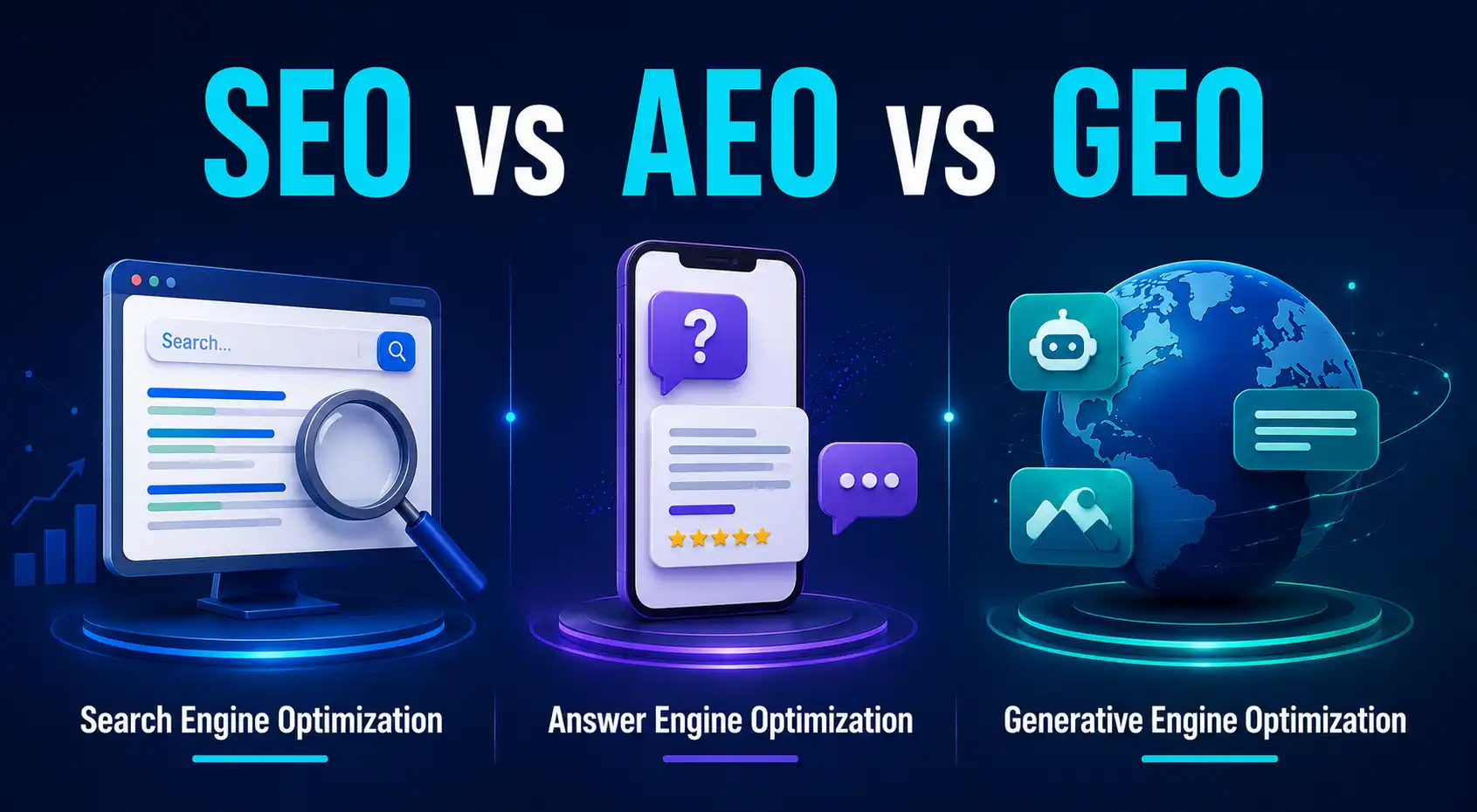
In 2026, ranking on Google alone is no longer enough. Brands must optimize for search engines, answer engines, and generative AI platforms simultaneously. This has introduced three essential optimization approaches: Search Engine Optimization (SEO), Answer Engine Optimization (AEO), and Generative Engine Optimization (GEO).
Understanding AEO vs SEO vs GEO 2026 is crucial for businesses that want to maintain online visibility, attract qualified traffic, and build authority across AI-driven search experiences. While SEO helps websites rank in search results, AEO focuses on providing direct answers to users’ questions, and GEO ensures your content is understood, referenced, and cited by generative AI systems.
This comprehensive AI search optimisation guide India explains the differences, strategies, benefits, and best practices that businesses should follow to stay ahead in the rapidly changing search landscape.
What is SEO and core SEO strategies in 2026?
What is SEO?
Search Engine Optimization (SEO) is the process of improving a website’s visibility in search engines like Google and Bing. The goal is to increase organic traffic by making content more relevant, trustworthy, and technically optimized for search engine algorithms.
Although AI has transformed search, SEO remains the foundation of digital visibility. Without strong SEO, it becomes difficult for AI systems and search engines to discover and understand your content.
In 2026, SEO is no longer just about ranking for keywords. It focuses on delivering high-quality user experiences, topical authority, content relevance, technical performance, and trustworthiness.
SEO Core Strategies & Key SEO Ranking Factors in 2026
1. Search Intent Optimization
Modern SEO prioritizes understanding why users search rather than simply targeting keywords. Content should address informational, navigational, commercial, or transactional intent effectively.
2. High-Quality Content
Google increasingly rewards content that demonstrates expertise, originality, and value. Comprehensive, well-researched articles perform better than keyword-stuffed pages.
3. E-E-A-T Signals
Experience, Expertise, Authoritativeness, and Trustworthiness (E-E-A-T) continue to play a major role in search rankings. Businesses should showcase author credentials, industry expertise, customer testimonials, and credible references.
4. Technical SEO
Technical optimization remains essential, including:
- Fast loading speed
- Mobile responsiveness
- HTTPS security
- Crawlability
- XML sitemaps
- Core Web Vitals optimization
5. Internal Linking
Strong internal linking helps search engines understand website hierarchy while improving user navigation.
6. Entity Optimization
Rather than relying only on keywords, search engines increasingly recognize entities such as brands, people, products, services, and locations.
7. Content Freshness
Regularly updating blogs, statistics, and resources signals relevance to both search engines and AI systems.
What is Answer Engine Optimization? And how do AEO strategies work?
What is answer engine optimization?
Answer Engine Optimization (AEO) is the process of optimizing content so that AI-powered answer engines can directly extract and display accurate answers to user questions.
Unlike traditional SEO, which aims for webpage rankings, Answer Engine Optimization India focuses on earning featured snippets, AI overviews, voice search responses, and direct answer boxes.
Users increasingly ask conversational questions like the following:
- What is GEO optimization?
- How does AI search work?
- Which SEO strategy works in 2026?
AEO helps ensure your content becomes the answer.
How AEO Strategies Work
1. Create Question-Based Content
Structure content around the actual questions users ask. Examples include:
- What is AI search optimization?
- How does GEO differ from SEO?
- Why is AEO important?
Question-focused headings improve answer visibility.
2. Optimize FAQs
Dedicated FAQ sections help answer engines identify concise responses quickly. Each answer should be clear, factual, and between 40-80 words where appropriate.
3. Use Structured Formats
Organize content using:
- Bullet points
- Numbered lists
- Comparison tables
- Definitions
- Step-by-step guides
Well-structured content is easier for AI systems to interpret.
4. Implement Schema Markup
Schema markup helps search engines understand content context. Important schema types include:
- FAQ Schema
- How-To Schema
- Organization Schema
- Article Schema
- Product Schema
- Local Business Schema
Structured data increases eligibility for rich results and AI-generated summaries.
What is Generative Engine Optimization? And How Do GEO Strategies Work?
What is Generative Engine Optimization?
Generative Engine Optimization (GEO) is the practice of optimizing content specifically for AI-powered search engines and generative AI models. Instead of simply ranking pages, GEO focuses on increasing the likelihood that AI systems cite, summarize, recommend, or reference your content when generating answers. As AI search becomes mainstream, GEO is becoming an essential part of every AI search optimization strategy.
How Do GEO Strategies Work?
1. Optimize Content for AI Understanding
AI models prefer content that is:
- Accurate
- Well-organized
- Comprehensive
- Factually consistent
Instead of writing solely for search engines, create content that AI can easily interpret and summarize.
2. Clear Content Structure
Use logical formatting with:
- H2 and H3 headings
- Short paragraphs
- Bullet points
- Lists
- Tables
- Summaries
Clear organization improves AI comprehension.
3. Create Entity-Based Content
AI understands relationships between entities better than isolated keywords. Mention:
- Brand names
- Industry terms
- Services
- Products
- Locations
- Recognized organizations
Building topical authority around these entities increases the likelihood of AI citations.
4. Build Brand Authority and Trust Signals
AI platforms are more likely to reference brands that demonstrate credibility. Ways to build trust include:
- Publishing original research
- Displaying author information
- Earning backlinks
- Collecting genuine customer reviews
- Maintaining consistent brand messaging
- Updating content regularly
AEO vs SEO vs GEO: Key Differences Explained
| Aspect | SEO (Search Engine Optimization) | GEO (Generative Engine Optimization) | AEO (Answer Engine Optimization) |
|---|---|---|---|
| Primary Goal | Improve rankings on search engine result pages (SERPs) | Get content featured in AI-generated responses and AI search results | Provide direct answers in search snippets, voice search & answer platforms |
| Main Platforms | Google, Bing, Yahoo and other search engines | ChatGPT, Google AI Overviews, Gemini, Perplexity, Claude & AI search engines | Google Featured Snippets, Voice Assistants, Knowledge Panels, Answer Engines |
| Main Focus | Keywords, backlinks, technical SEO, and content optimization | Context, entities, topical authority, semantic SEO, structured data, AI understanding | User questions, concise answers, FAQ content, schema markup, search intent |
| Content Style | Keyword-focused blogs, landing pages, guides, optimized website content | In-depth, conversational, expert-level content with context and credibility | Short, clear, direct answers in Q&A format, lists, tables & FAQs |
| User Intent | Users search, compare, and explore information | Users seek insights, recommendations, and information through AI conversations | Users want quick and accurate answers instantly |
| Ranking Factors | Keywords, backlinks, website authority, page speed, technical SEO | Brand mentions, content depth, expertise, entity relationships, AI readability | Clear answers, structured data, FAQs, question-based optimization |
| Success Metrics | Organic traffic, keyword rankings, CTR, backlinks, conversions | AI visibility, brand mentions in AI responses, referral traffic, authority | Featured snippets, voice search visibility, zero-click search results |
| Key Tools | Google Search Console, Ahrefs, SEMrush, Screaming Frog, GA4 | Surfer SEO, Clearscope, MarketMuse, AlsoAsked, AI tracking tools | Schema Markup tools, Google Search Console, Answer The Public |
Understanding the difference between SEO, AEO, and GEO helps businesses create a well-rounded digital strategy rather than relying on a single optimization method.
How SEO, AEO, and GEO Work Together for Better Search Visibility
The future of search isn’t about choosing one optimization strategy over another. The most successful businesses combine all three.
Create SEO-Friendly Content
Start with keyword research, optimize on-page elements, improve technical SEO, and create comprehensive content that addresses user intent.
Optimize Content for Direct Answers
Incorporate FAQs, concise definitions, and structured explanations to improve visibility in AI-generated answers and featured snippets.
Improve AI Search Understanding
Write naturally, organize information clearly, and use semantic relationships so AI models can accurately interpret your content.
Build Brand Trust Signals
Strengthen authority through:
- Expert-written content
- High-quality backlinks
- Customer reviews
- Case studies
- Consistent publishing
- Author profiles
Trust is becoming a major ranking factor across search engines and AI platforms.
Schema Implementation
Structured data remains one of the most effective ways to improve machine understanding. The recommended schema includes the following:
- Organization
- FAQ
- Article
- Breadcrumb
- Product
- Local Business
- Review Schema
Combining these approaches creates a complete AEO SEO GEO optimization strategy that improves visibility across both traditional and AI-powered search.
Common Mistakes When Optimizing for AEO, SEO, and GEO
Even experienced marketers make mistakes that limit search performance.
Ignoring Structured Data
Without schema markup, search engines and AI systems may struggle to understand page content correctly.
Focusing Only on Keywords
Modern search algorithms prioritize relevance, context, and user intent over exact-match keywords.
Ignoring Search Intent
Ranking for keywords that don’t satisfy user expectations often leads to poor engagement and lower visibility.
Creating Content Without Expertise
Generic AI-generated articles lacking originality, practical insights, or credibility rarely build long-term authority. Demonstrating real expertise, industry experience, and first-hand knowledge helps improve both SEO performance and AI trust.
Neglecting Traditional SEO and E-E-A-T
Some marketers assume AI optimization replaces SEO. In reality, GEO and AEO build upon strong SEO fundamentals. Technical optimization, backlinks, content quality, and E-E-A-T remain critical for long-term success.
What Are the Benefits of AI Search Optimization?
Adopting a comprehensive AI search optimization strategy offers significant long-term advantages.
Higher Visibility
Businesses can appear across traditional search results, AI overviews, featured snippets, voice search, and generative AI responses.
Better User Engagement
Answer-focused content improves user satisfaction by delivering relevant information quickly and clearly.
More Qualified Traffic
Visitors arriving through AI recommendations often have stronger intent, resulting in better engagement and higher conversion potential.
Direct AI Citations
One of the biggest advantages of GEO is the opportunity for your brand to be referenced directly by AI-powered search platforms, increasing authority and brand recognition.
As Search Engine Optimization trends in 2026 continue evolving, businesses that optimize for AI visibility today will gain a lasting competitive advantage.
Conclusion
The future of search is no longer limited to traditional search engine rankings. AI-powered search experiences are changing how users discover information, compare brands, and make purchasing decisions.
Understanding AEO vs SEO vs GEO 2026 is essential for businesses that want to stay competitive. While SEO continues to drive organic visibility, AEO helps content become the preferred answer for users, and GEO positions brands for recognition within AI-generated responses.
Rather than treating these strategies as competitors, businesses should integrate them into a unified AI search optimization strategy. By combining technical SEO, structured content, schema implementation, authoritative publishing, and AI-friendly optimization, organizations can improve visibility across search engines, answer engines, and generative AI platforms.
As AI continues to reshape digital discovery, investing in AEO SEO GEO optimization today will help businesses remain visible, credible, and future-ready in 2026 and beyond.