
Table of Contents
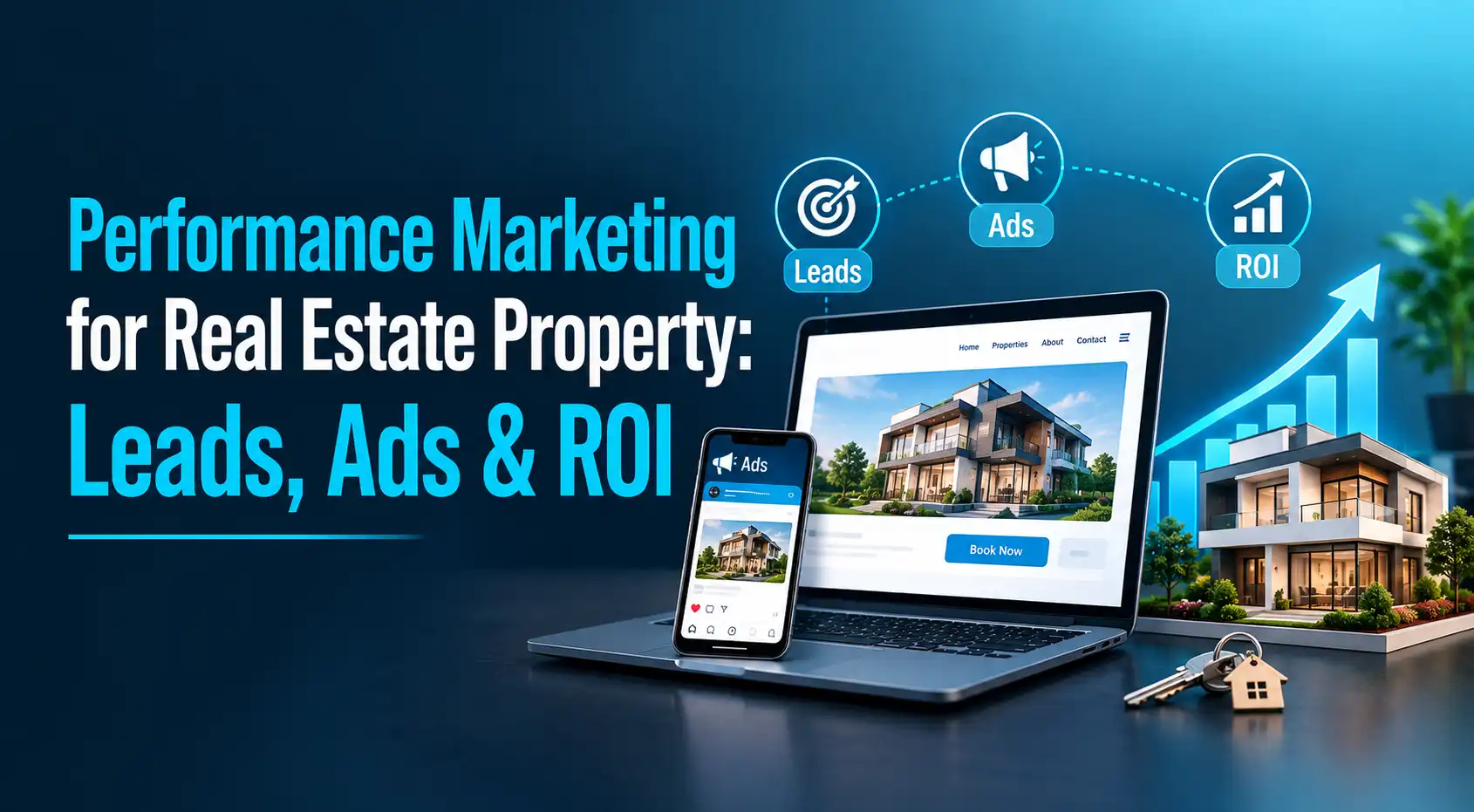
TogglePerformance marketing for real estate uses measurable digital campaigns to generate property enquiries, qualified leads, site visits, and bookings. By combining Google Ads, real estate Meta Ads, retargeting, CRM automation, and conversion tracking, developers can optimize advertising spend and improve ROI.
Introduction
Real estate buyers increasingly discover properties through search engines, social media, videos, and digital platforms. Performance marketing for real estate helps developers and agents turn this online attention into measurable business outcomes. Instead of focusing only on visibility, businesses can track leads, site visits, bookings, advertising costs, and overall returns.
What Is Performance Marketing for Real Estate Property?
Performance marketing for real estate is a results-driven approach to digital advertising where campaigns are planned, tracked, and optimized based on measurable outcomes. These outcomes can include property enquiries, qualified leads, phone calls, WhatsApp enquiries, site visits, appointments, and bookings.
Unlike traditional advertising, where it can be difficult to determine exactly how many customers responded to an advertisement, digital campaigns allow businesses to track user interactions throughout the buying journey.
For real estate businesses, this means campaigns can be optimized based on actual performance. If a particular audience, property advertisement, keyword, or creative generates better-quality leads, more budget can be directed toward those opportunities.
| Traditional Real Estate Advertising | Performance Marketing |
|---|---|
| Focuses on visibility | Focuses on measurable outcomes |
| Reach & impressions | Leads & qualified leads |
| Broad targeting | Audience segmentation |
| Offline-heavy measurement | Digital tracking |
| Difficult attribution | Campaign-level attribution |
| Brand awareness | Leads → Site Visits → Bookings |
A strong real estate advertising strategy can combine both approaches. Traditional advertising can support brand awareness, while performance campaigns focus on measurable lead generation and conversion.
What Outcomes Can Real Estate Performance Marketing Generate?
A well-structured campaign can support multiple stages of the property buyer journey. Depending on the campaign objective and sales process, businesses can generate:
- Property enquiries
- Qualified leads
- Phone calls
- WhatsApp enquiries
- Site visits
- Booking appointments
- Applications/EOIs
- Property bookings
The quality of these outcomes depends on factors such as targeting, property positioning, advertising creatives, landing pages, lead qualification, follow-up processes, and campaign optimization.
Best Performance Marketing Channels for Real Estate Property
Google Ads for Real Estate
Google Ads allows real estate businesses to reach users who are actively searching for properties, locations, and related services. Different campaign formats can be used depending on the objective:
- Search Ads: Search campaigns can target users searching for specific property types, locations, configurations, or real estate-related services. These campaigns can be particularly useful when users already demonstrate purchase intent.
- Performance Max: Performance Max campaigns can help advertisers reach audiences across multiple Google properties through a unified campaign structure. Businesses can use relevant creative assets, audience signals, and conversion goals to support lead-generation objectives.
- Display/Remarketing: Display and remarketing campaigns can reconnect with people who have previously interacted with the website or property content. These campaigns can keep a project visible while users continue evaluating their options.
- YouTube Ads: YouTube advertising can use property walkthroughs, lifestyle videos, testimonials, and other visual content to introduce properties to relevant audiences.
- Local Ads: Local-focused campaigns can help businesses reach audiences searching for properties or real estate services in specific geographic areas.
Meta Ads for Real Estate
Meta provides access to Facebook and Instagram audiences and offers multiple formats for property promotion:
- Facebook Ads: Businesses can promote properties, projects, offers, and educational content to selected audience segments.
- Instagram Ads: Instagram is useful for visually showcasing properties through images, Reels, Stories, and video advertisements.
- Lead Ads: Lead Ads allow interested users to submit their information through a platform-based form, reducing the steps required to make an enquiry.
- Website Conversion Campaigns: Businesses can direct users to dedicated landing pages and optimize campaigns around conversion actions.
- Video/Reels Ads: Short-form property videos, walkthroughs, lifestyle content, and project highlights can capture attention and communicate property features quickly.
- Retargeting: Retargeting can reconnect with users who have already interacted with the business or its content but have not yet converted.
- Lookalike Audiences Where Applicable: Where sufficient first-party audience data is available and platform functionality supports it, lookalike audiences can help businesses reach users with characteristics similar to existing customers or qualified leads.
YouTube Ads for Property Marketing
Video is particularly effective for real estate because properties are highly visual. YouTube Ads can help businesses demonstrate spaces, amenities, locations, and lifestyle benefits.
Useful video formats include:
- Project walkthroughs
- Drone videos
- Lifestyle videos
- Customer testimonials
- Construction progress
- Short-form property videos
A well-produced video can provide potential buyers with a better understanding of a property before they schedule a physical visit.
Retargeting Campaigns
Not every user converts during their first interaction with a property advertisement. Retargeting allows businesses to reconnect with audiences who have already demonstrated interest.
These audiences may include people who:
- Visited the website
- Viewed a property page
- Watched a project video
- Opened a lead form
- Engaged with Instagram/Facebook
- Started but didn’t complete an enquiry
Retargeting campaigns can deliver relevant reminders and additional information to users who are already familiar with the property or brand.
How to Measure Real Estate Performance Marketing ROI
Measuring campaign performance requires more than counting total leads. Real estate businesses should track metrics throughout the customer journey to understand both advertising efficiency and sales effectiveness.
| Metric | What It Measures |
|---|---|
| CTR | Ad engagement |
| CPC | Cost of traffic |
| CPL | Cost of lead |
| Qualified CPL | Cost of qualified lead |
| Site Visit Rate | Lead-to-visit efficiency |
| Cost per Site Visit | Acquisition efficiency |
| Booking Rate | Sales effectiveness |
| CAC | Customer acquisition cost |
| ROAS | Revenue generated vs ad spend |
| ROI | Overall return on investment |
- CTR (Click-Through Rate) indicates how effectively an advertisement encourages users to click.
- CPC (Cost Per Click) measures the average cost of acquiring traffic through an advertising campaign.
- CPL (Cost Per Lead) shows how much advertising spend is required to generate one lead.
- Qualified CPL provides a more useful view for real estate because not every lead is equally valuable. It measures the cost of generating leads that meet defined qualification criteria.
- Site Visit Rate shows how effectively leads move from initial inquiry to an actual property visit.
- Cost per site visit measures how much advertising expenditure is required to generate a confirmed site visit.
- Booking Rate helps evaluate how effectively generated opportunities translate into property bookings.
- CAC (Customer Acquisition Cost) measures the total cost associated with acquiring a customer.
- ROAS (Return on Ad Spend) compares revenue attributed to advertising with the advertising expenditure.
- ROI (Return on Investment) provides a broader view by considering overall marketing costs and revenue.
How to Calculate Real Estate Advertising ROI
Real estate advertising performance can be measured using several simple formulas:
- CPL
Ad Spend ÷ Total Leads = Cost Per Lead
For example, if a campaign spends ₹50,000 and generates 250 leads:
₹50,000 ÷ 250 = ₹200 CPL - Qualified CPL
Ad Spend ÷ Qualified Leads = Cost Per Qualified Lead
This metric helps businesses understand the cost of generating leads that are more likely to move forward in the sales process. - Cost Per Site Visit
Ad Spend ÷ Confirmed Site Visits = Cost Per Site Visit
This provides a clearer picture of acquisition efficiency because site visits are generally a stronger buying signal than initial enquiries. - ROAS
Revenue Attributed to Advertising ÷ Ad Spend = ROAS
For example, if advertising generates 10 lakh in attributed revenue from 2 lakh in ad spend:
10 lakh ÷ 2 lakh = 5X ROAS - ROI
(Revenue − Total Marketing Cost) ÷ Total Marketing Cost × 100
ROI provides a broader assessment of campaign profitability by considering the overall marketing investment rather than advertising spend alone.
How CRM and WhatsApp Automation Improve Real Estate Ad ROI
Generating a lead is only the beginning of the real estate sales journey. Quick responses, effective qualification, and consistent follow-up can significantly influence whether an enquiry becomes a site visit or booking.
Instant Lead Response
Automated systems can notify sales teams immediately when a new lead arrives. Faster responses can help businesses connect with potential buyers while their interest is still active.
Automated Qualification
CRM and automation systems can collect information such as preferred location, property type, budget, and buying timeline. This helps sales teams prioritize and manage leads more efficiently.
Multimedia Showcasing
WhatsApp can be used to share brochures, floor plans, property images, videos, location information, and other relevant project details with potential buyers.
Site Visit Reminders
Automated reminders can help reduce missed appointments by reminding prospects about scheduled site visits and providing necessary information beforehand.
Lead Status Tracking
A CRM can organize leads according to their current stage, such as new enquiry, contacted, qualified, site visit scheduled, site visit completed, negotiation, or booking. This visibility helps marketing and sales teams understand campaign quality and identify opportunities for improvement.
How Niction Tech Approaches Real Estate Performance Marketing
Niction Tech approaches real estate performance marketing by combining strategy, creative communication, targeted advertising, lead generation, and performance measurement. The objective is to connect advertising activity with meaningful business outcomes rather than focusing only on impressions or clicks.
Campaigns can be planned around the property’s location, audience, positioning, configuration, amenities, pricing, and buyer intent. Google Ads, Meta Ads, video campaigns, remarketing, landing pages, and creative assets can work together as part of an integrated real estate advertising strategy.
Performance data is then used to evaluate campaign quality, identify stronger audiences and creatives, monitor lead costs, and optimize campaigns based on measurable outcomes. By connecting advertising with lead management and conversion tracking, Niction Tech helps real estate brands build a more structured approach to digital customer acquisition.
Conclusion
Performance marketing has transformed how real estate businesses approach digital advertising. Instead of measuring success only through visibility, brands can track the complete journey from property advertisements and enquiries to qualified leads, site visits, and bookings.
A successful real estate performance marketing strategy combines the right platforms, accurate targeting, compelling creatives, optimized landing pages, retargeting, CRM automation, and detailed performance measurement. By continuously analyzing metrics such as CPL, qualified CPL, site visit rate, ROAS, and ROI, real estate businesses can make smarter decisions about their advertising investment.