
Table of Contents
ToggleCategory
- Blog
- Branding
- Digital Marketing
- Graphic Design
- Nictiontech
- Real Estate
- Social Media Marketing
- Video Marketing
- Video Production
- Website Design
Recent Posts
- 5 Hidden Metrics That Prove Your Ads Are Suffering from Creative Fatigue
- How Al Is Changing Digital Marketing Services in India
- Performance Marketing for Real Estate Property: Leads, Ads & ROI
- How to Get Your Brand Mentioned in ChatGPT and AI Search Results
- How Real Estate Brands Can Use Reels & Shorts to Sell Properties
Introduction
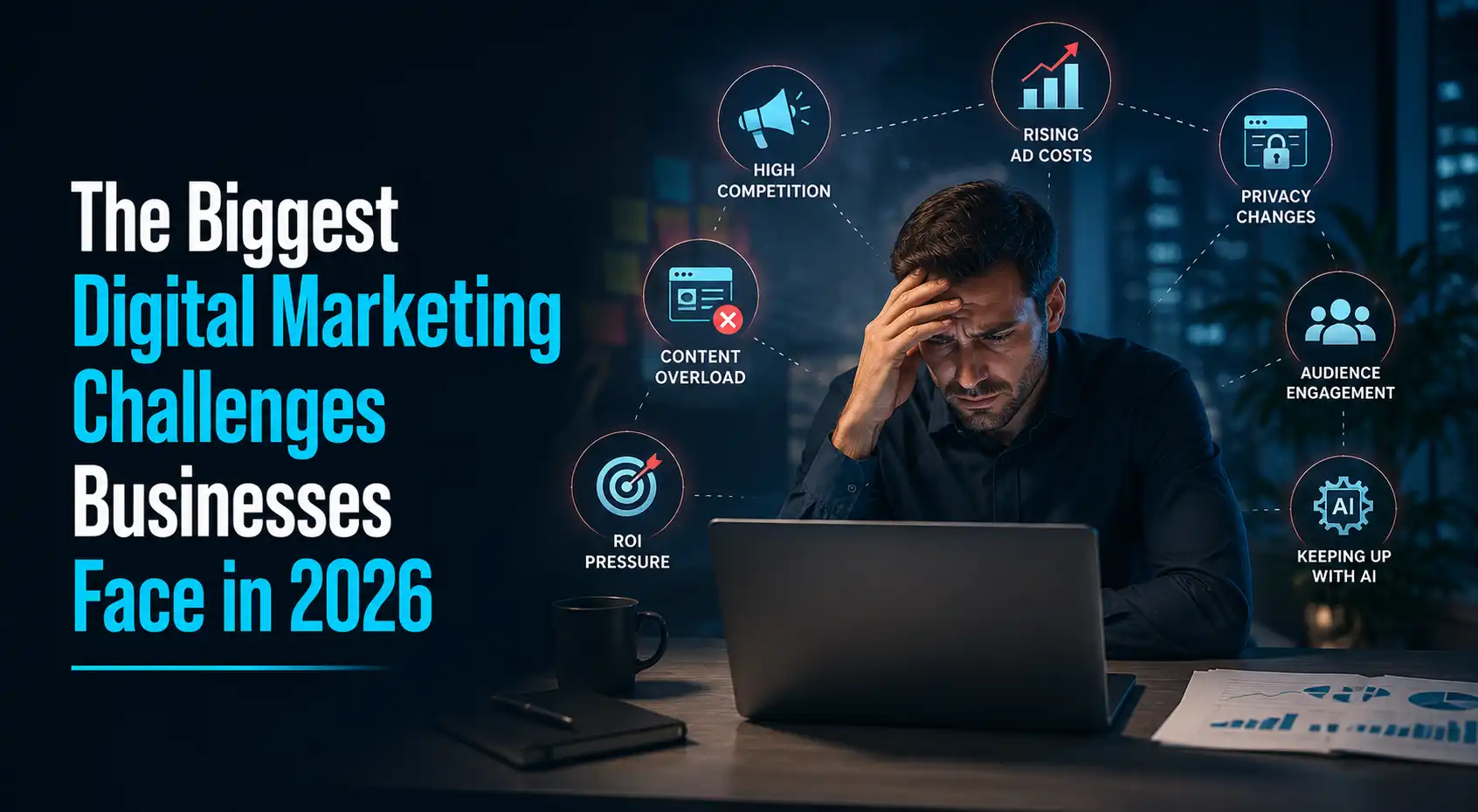
Digital marketing continues to evolve at an unprecedented pace. Artificial intelligence, changing search behavior, stricter privacy regulations, and rising advertising costs are reshaping how businesses attract and convert customers. To stay competitive, brands must continuously adapt their Digital Marketing Strategy while embracing emerging technologies and consumer expectations. Understanding the biggest Digital Marketing Challenges 2026 presents is the first step toward building sustainable long-term growth.
Why Digital Marketing Has Become More Challenging in 2026
The digital marketing landscape has become increasingly complex as businesses compete across multiple channels while consumer behavior continues to evolve. Traditional SEO techniques are no longer enough, paid advertising has become more expensive, and Al-powered search experiences are changing how users discover information.
Consumers now expect personalized experiences across websites, search engines, social media platforms, email, and messaging apps. At the same time, Google continues introducing Al-driven search features, reducing organic website clicks through Al overviews and zero-click searches.
Businesses must also manage increasing competition from Al-generated content, adapt to frequent algorithm updates, measure marketing performance more accurately, and deliver consistent customer experiences across every digital touchpoint. These rapid changes make flexibility and continuous optimization essential components of every successful digital marketing strategy.
Biggest Digital Marketing Challenges Businesses Face in 2026
1. Al Search & Zero-Click Searches Are Reducing Website Traffic
AI-powered search experiences such as Google AI Overviews are changing how users consume information. Instead of clicking through to websites, users often receive complete answers directly on the search results page.
This shift has reduced organic traffic for many businesses, particularly informational websites that previously relied on traditional search rankings.
Problems
- Users get answers without visiting websites.
- Organic traffic is declining.
- Lower click-through rates (CTR).
Solutions
- Optimize for AI Search (AEO & GEO).
- Create FAQ and answer-focused content.
- Build topical authority with expert content.
2. Content Saturation & AI-Generated Content
AI tools have dramatically increased content production across every industry. While creating content has become easier, standing out has become significantly more difficult.
Search engines increasingly prioritize original insights, firsthand experience, and authoritative expertise over generic AI-generated articles.
Problems
- AI-generated content is everywhere.
- High competition in search results.
- Generic content gets ignored.
Solutions
- Publish original insights and case studies.
- Focus on E-E-A-T principles.
- Update existing content regularly.
3. Rising Google Ads & Meta Ads Costs
Increasing competition has driven advertising costs higher across Google Ads and Meta platforms. Many industries now experience significantly higher cost-per-click (CPC) and customer acquisition costs than previous years.
Without proper optimization, businesses may spend larger budgets while generating fewer qualified leads.
Problems
- Cost-per-click (CPC) keeps rising.
- Higher customer acquisition costs.
- Lower ROI from paid campaigns.
Solutions
- Improve audience targeting.
- Optimize landing pages for conversions.
- Continuously A/B test ad creatives.
4. Measuring Marketing ROI Accurately
Today’s customer journey often spans multiple devices, channels, and interactions before a purchase occurs. This makes accurately attributing conversions increasingly challenging.
Privacy regulations, cookie restrictions, and fragmented customer journeys have further complicated marketing measurement.
Problems
- Customer journeys are fragmented.
- Attribution is inaccurate.
- Privacy changes reduce tracking.
Solutions
- Use first-party data.
- Set clear KPIs and conversion tracking.
- Use analytics dashboards for reporting
5. Constant Google Algorithm Updates
Google frequently updates its ranking algorithms to improve search quality. While these updates benefit users, they often create uncertainty for businesses relying heavily on organic search traffic.
Websites that fail to adapt may experience sudden ranking fluctuations or traffic declines.
Problems
- Sudden ranking fluctuations.
- Organic traffic drops.
- Outdated SEO practices become ineffective.
Solutions
- Publish helpful, user-first content.
- Perform regular SEO audits.
- Monitor algorithm updates and adapt.
6. Social Media Organic Reach Is Declining
Organic visibility on major social media platforms continues to decrease as algorithms prioritize personalized content and paid promotions. Brands that previously relied on organic posting now struggle to reach existing followers consistently.
Problems
- Fewer followers see your posts.
- Engagement rates are dropping.
- Algorithms favor paid content.
Solutions
- Create engaging, shareable content.
- Build communities instead of just followers.
- Support organic efforts with paid campaigns.
7. Generating High-Quality Leads
Attracting visitors has become easier than generating qualified prospects who are genuinely interested in purchasing products or services.
Poor audience targeting, ineffective messaging, and weak conversion experiences often result in large numbers of low-quality leads.
Problems
- Low-quality leads waste sales time.
- Poor audience targeting.
- Low conversion rates.
Solutions
- Define your ideal customer profile.
- Use lead qualification forms.
- Create personalized nurturing campaigns.
8. Omnichannel Customer Journeys
Modern customers interact with brands through multiple channels before making purchasing decisions. They may discover a business through Google Search, research products on social media, read reviews, visit the website, subscribe to emails, and finally complete a purchase through another device.
Providing a consistent experience across every touchpoint has become increasingly challenging.
Problems
- Inconsistent customer experience.
- Data scattered across platforms.
- Disconnected marketing channels.
Solutions
- Integrate CRM and marketing tools.
- Maintain consistent messaging across channels.
- Track the complete customer journey.
Future-Proof Digital Marketing: Enduring Strategies for 2026
As digital marketing continues to evolve, businesses must move beyond traditional tactics and adopt strategies that can withstand rapid technological and consumer behavior changes. The following trends are shaping the future of marketing and will help brands stay competitive in 2026 and beyond.
Al Search Optimization (AEO & GEO)
Traditional SEO alone is no longer enough. With Google Al Overviews, conversational search, and Al-powered assistants becoming more prominent, businesses must optimize their content for Al Search Optimization (AEO & GEO).
Answer Engine Optimization (AEO) focuses on creating concise, accurate, and authoritative content that directly answers user queries, increasing the chances of appearing in Al-generated responses and featured snippets.
Generative Engine Optimization (GEO) takes this a step further by optimizing content so Al platforms such as ChatGPT, Google Al, Gemini, and other generative search engines can easily understand, reference, and recommend your content.
Businesses should:
- Create question-and-answer-based content.
- Use structured data and schema markup.
- Publish original insights backed by expertise.
- Improve E-E-A-T (Experience, Expertise, Authoritativeness, and Trustworthiness).
- Regularly update content to keep it relevant and accurate.
Brands that embrace Al search optimization today will have a significant advantage as Al-driven search continues to grow.
Community-Led Marketing
Consumers trust communities more than advertisements. Instead of only broadcasting promotional messages, successful brands are building engaged communities where customers actively participate in discussions, share experiences, and advocate for the brand.
Community-led marketing focuses on creating meaningful relationships through platforms like LinkedIn Groups, Facebook Communities, Discord servers, WhatsApp Channels, Reddit, and exclusive customer forums.
An active community helps businesses:
- Build long-term customer loyalty.
- Increase organic word-of-mouth marketing.
- Gather valuable customer feedback.
- Improve customer retention.
- Generate authentic user-generated content.
Rather than viewing customers as one-time buyers, businesses should nurture them into long-term brand advocates.
Al Agents
Artificial intelligence is evolving beyond chatbots into intelligent Al agents capable of automating complex marketing tasks.
AI agents can assist businesses by:
- Managing customer interactions.
- Personalizing website experiences.
- Automating email marketing campaigns.
- Qualifying leads.
- Scheduling appointments.
- Generating campaign reports.
- Assisting with content planning and research.
Instead of replacing marketers, AI agents help marketing teams work more efficiently by automating repetitive tasks while allowing professionals to focus on creativity, strategy, and relationship building.
As Marketing Automation continues to advance, AI agents will become an essential part of modern marketing operations.
Creator Economy
The creator economy continues to reshape digital marketing. Consumers increasingly trust individual creators who provide authentic recommendations over traditional advertisements.
Brands are moving away from one-time sponsored posts and focusing on long-term creator partnerships that build credibility and audience trust.
Instead of collaborating only with celebrities, businesses are partnering with nano and micro-influencers who often deliver higher engagement rates within niche communities.
Successful creator collaborations include the following:
- Product reviews.
- Educational content.
- Live sessions.
- Behind-the-scenes videos.
- Tutorials.
- User-generated content campaigns.
- Brand ambassador programs.
Building genuine relationships with creators helps businesses reach highly targeted audiences while increasing brand authenticity.
Video-First Strategies
Video has become one of the most influential content formats across nearly every digital platform. Short-form videos, live streams, webinars, product demonstrations, and educational content continue to dominate user engagement.
Consumers increasingly prefer watching videos over reading lengthy content when researching products or services.
Businesses should prioritize creating the following:
- Short-form videos for Instagram Reels, YouTube Shorts, and TikTok.
- Product demonstrations.
- Customer testimonials.
- Educational tutorials.
- Behind-the-scenes content.
- Live Q&A sessions.
- Thought leadership videos.
A video-first approach not only improves engagement but also supports SEO, social media marketing, and overall brand visibility across multiple channels.
Conclusion
The Digital Marketing Challenges 2026 presents are more complex than ever before. AI-powered search, increasing competition, higher advertising costs, declining organic reach, and evolving customer expectations require businesses to rethink how they approach digital marketing.
Rather than relying on outdated tactics, brands should build a future-ready Digital Marketing Strategy that combines SEO, Performance Marketing, Marketing Automation, AI Search Optimization, valuable content, and meaningful customer relationships. Businesses that remain adaptable, embrace innovation, and continuously optimize their marketing efforts will be better positioned for sustainable growth in an increasingly competitive digital landscape.