
Table of Contents
ToggleCategory
- Blog
- Branding
- Digital Marketing
- Graphic Design
- Nictiontech
- Real Estate
- Social Media Marketing
- Video Marketing
- Video Production
- Website Design
Recent Posts
- 5 Hidden Metrics That Prove Your Ads Are Suffering from Creative Fatigue
- How Al Is Changing Digital Marketing Services in India
- Performance Marketing for Real Estate Property: Leads, Ads & ROI
- How to Get Your Brand Mentioned in ChatGPT and AI Search Results
- How Real Estate Brands Can Use Reels & Shorts to Sell Properties
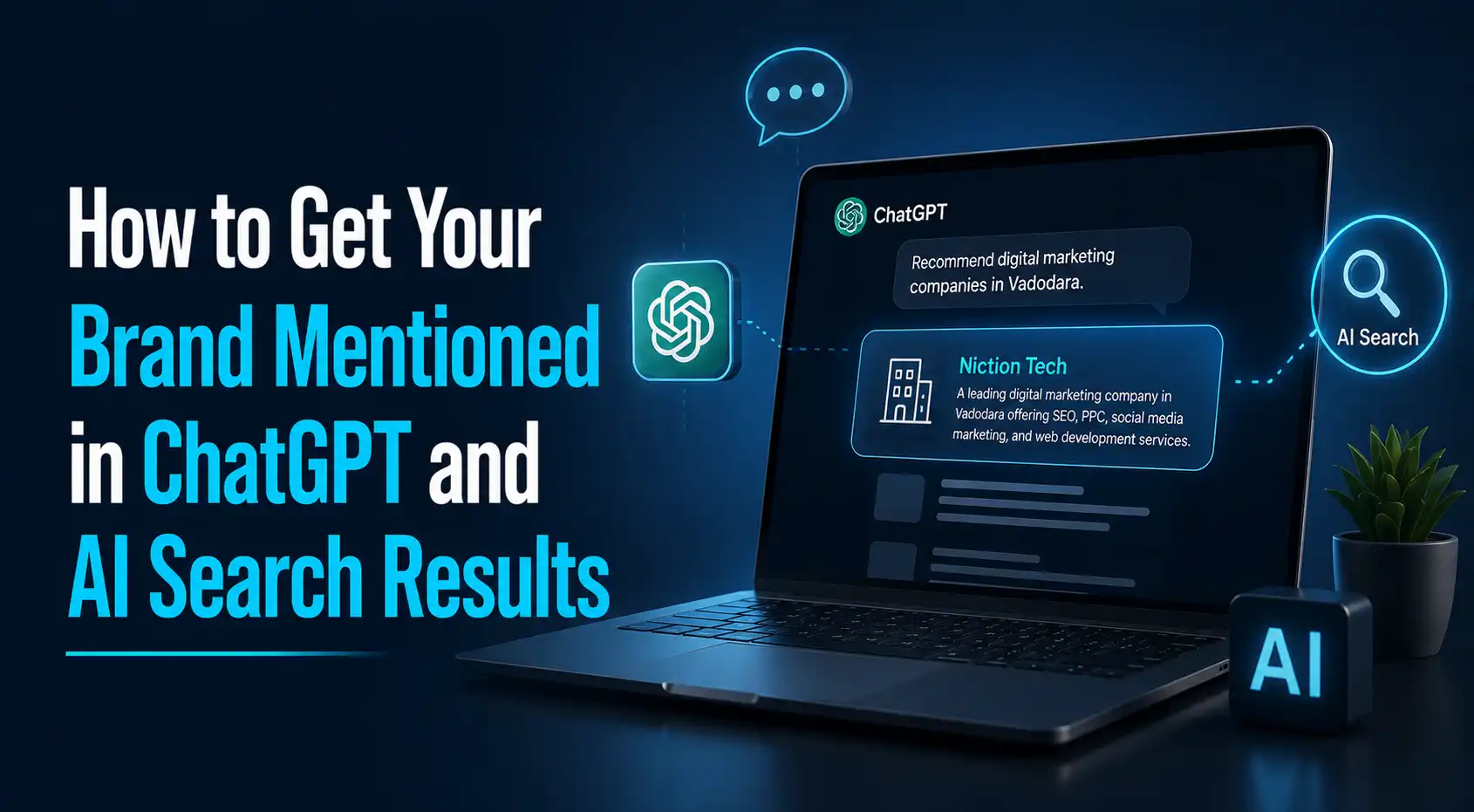
To increase brand mentions in ChatGPT and other AI search results, businesses should build clear brand entities, publish answer-focused and authoritative content, maintain strong technical SEO, earn credible third-party mentions, and create original information that AI systems can understand, retrieve, and cite.
Introduction
Search visibility is no longer limited to ranking on traditional search engine results pages. AI-powered platforms can now generate direct answers, recommendations, comparisons, and brand suggestions. As users increasingly rely on AI-generated responses, businesses need to focus on brand visibility in AI search, AI citations, entity recognition, and authoritative content to improve their chances of being discovered and mentioned.
How Does ChatGPT Decide Which Brands to Mention?
AI systems can mention brands based on the information available to them and the context of a user’s query. A brand’s visibility can depend on how clearly it is represented across reliable sources and whether relevant information can be identified for a particular question.
1. Training & Existing Web Knowledge
AI models are trained on large amounts of information and can develop knowledge about brands, products, services, industries, and entities from information available in their training data.
If a brand has an established presence across its website, publications, articles, directories, media coverage, and other relevant sources, it may be easier for AI systems to understand what the business does and where it fits within a particular industry.
However, businesses should not assume that simply publishing content guarantees a mention. The information should be clear, relevant, and consistently associated with the brand.
2. Live Web Retrieval
Some AI search experiences can retrieve information from the live web when responding to a query. In these situations, a brand may have an opportunity to appear when its content is relevant to the user’s question.
For example, if a user asks for recommendations, comparisons, services, products, or industry information, AI systems may look for relevant and reliable sources to support the response. This makes AI search optimization increasingly connected to overall search visibility, content quality, authority, and accessibility.
3. Entity Recognition
An entity is a clearly identifiable person, business, organization, product, place, or concept. AI systems need to understand what your brand is, what it offers, and how it relates to specific topics or industries.
For example, a business should make it easy to understand:
- Its official brand name
- Products or services offered
- Industry or category
- Primary locations or markets served
- Areas of expertise
- Relationship between the brand and its key offerings
Clear entity information can improve consistency and reduce confusion when AI systems process information about the business.
4. Third-Party Corroboration
Information published only on a company’s own website may not always provide the strongest external validation. Third-party sources can help corroborate information about a business.
Relevant mentions may come from industry publications, news articles, business directories, partner websites, reviews, expert articles, interviews, podcasts, and other credible sources. When independent sources consistently describe a brand in a similar way, it can strengthen the overall digital footprint associated with that business.
How to Increase Your Brand Visibility in ChatGPT and AI Search
1. Make Your Brand Entity Clear
Start by making your brand easy to understand. Your website should clearly communicate who you are, what your business does, who you serve, and the services or products you offer.
Use a consistent brand name across your website and other digital platforms. Important business information should not be hidden behind vague marketing language.
For example, instead of only writing a tagline such as “Building Better Digital Experiences,” clearly explain the business category and services:
“XYZ is a digital marketing agency providing SEO, performance marketing, social media marketing, branding, and creative services for businesses.”
Clear information helps search engines, AI systems, and users understand the brand entity and its relevance.
2. Create Answer-First Content
AI-powered search experiences are designed to answer user questions quickly. Businesses can improve content usefulness by providing clear answers near the beginning of relevant pages. Answer-first content should directly address questions before expanding into detailed explanations.
For example, instead of starting with several paragraphs of general information, answer the primary question first and then provide supporting details.
This approach can be useful for:
- Frequently asked questions
- Service-related questions
- Product comparisons
- Industry guides
- How-to content
- Pricing-related questions
- Location-specific queries
Clear and structured answers can make information easier to understand, retrieve, and reference.
3. Build Topical Authority
Publishing one article on a topic is rarely enough to establish strong topical relevance. Businesses should create useful content across the subjects most closely connected to their expertise.
For example, a digital marketing agency focusing on SEO could cover topics related to SEO audits, technical SEO, local SEO, keyword research, AI search optimization, content strategy, and performance measurement.
The goal is not simply to publish a large volume of content. Instead, create connected content that demonstrates genuine understanding of a subject. A strong topical presence can help establish the relationship between a brand and the topics it wants to be associated with.
4. Strengthen Your Website’s Technical SEO
Technical SEO remains an important foundation for AI SEO and traditional search visibility. If search engines and other systems cannot effectively access, crawl, understand, or index important website pages, even high-quality content may have limited visibility.
Important areas include:
- Crawlability
- Indexability
- Website speed
- Mobile usability
- Internal linking
- HTTPS security
- XML sitemaps
- Proper page structure
- Duplicate content issues
- Broken pages and links
A technically healthy website makes it easier for search systems to access and understand the information published on it.
5. Use Structured Data Where Appropriate
Structured data provides additional context about webpage content. When implemented appropriately, it can help search engines better understand entities and information available on a page.
Depending on the website and page type, relevant structured data may provide information about:
- Organizations
- Local businesses
- Products
- Services
- Articles
- FAQs
- Events
- Reviews
Structured data should accurately represent the visible content on the page. It should not be added simply to manipulate search results or include misleading information.
6. Build Consistent Brand Information Across the Web
Brand information should remain consistent across important digital platforms. This includes:
- Brand name
- Website
- Business description
- Products and services
- Contact information
- Social media profiles
- Location information
Inconsistent information can create confusion about whether multiple references belong to the same business. Businesses should regularly review major online profiles and update outdated or inaccurate information to maintain a clear and consistent digital presence.
7. Earn Third-Party Brand Mentions
Independent brand mentions can increase a company’s visibility beyond its own website. Businesses can earn relevant mentions through:
- Industry publications
- Media coverage
- Expert interviews
- Partner websites
- Case studies
- Podcasts
- Business directories
- Professional communities
- Customer reviews
The focus should be on earning relevant mentions rather than attempting to collect large numbers of low-quality references. A smaller number of credible, contextually relevant mentions can provide more value than numerous unrelated or low-quality placements.
8. Create Original, Citable Information
Original information can make a brand more valuable as a potential source. Businesses can create content based on:
- Original research
- Industry surveys
- Customer insights
- Case studies
- Internal data
- Market analysis
- Expert opinions
- Unique frameworks
For example, instead of publishing another general article about digital marketing trends, a company could conduct a survey, analyze campaign data, or publish an original industry report. Original information gives other websites, journalists, researchers, and content creators something specific to reference. It can also strengthen the brand’s authority around relevant topics.
9. Digital PR
Digital PR can help businesses increase awareness and earn relevant coverage from third-party sources. A digital PR strategy may include sharing:
- Original research
- Industry reports
- Expert commentary
- Business milestones
- Data-driven insights
- Case studies
- Newsworthy campaigns
The objective should be to create information that is genuinely useful or newsworthy rather than distributing generic promotional announcements. Relevant coverage can improve brand awareness while creating additional opportunities for credible third-party references.
How to Check If ChatGPT Mentions Your Brand
1. Create 10-20 Buyer Prompts
Create a list of realistic questions that potential customers may ask when looking for your products, services, or industry expertise.
For example, a user may ask:
- What are the best digital marketing agencies for real estate?
- Which company provides SEO services for businesses?
- How can I find a social media marketing agency in Gujarat?
The prompts should reflect real buyer questions rather than only searches containing your brand name.
2. Run Prompts Regularly
Test the same prompts periodically to understand whether and how your brand appears in AI-generated responses. Record whether your brand is mentioned, the context in which it appears, and which competitors or alternatives are included.
Results can vary depending on the wording of the prompt, user context, location, available information, and the AI system being used.
3. Identify Content & Authority Gaps
If competitors are regularly mentioned but your brand is not, review the differences between your digital presence. Look for possible gaps in:
- Content coverage
- Topical authority
- Third-party mentions
- Brand information
- Original research
- Technical SEO
- Industry relevance
The objective is to identify where competitors may have stronger evidence or clearer information rather than simply trying to copy their content.
4. Record
Create a simple tracking document to record:
- Prompt used
- Date tested
- AI platform
- Whether the brand was mentioned
- Position or context of the mention
- Competitors mentioned
- Sources or citations, where available
Tracking results over time can help businesses identify changes in brand visibility.
5. Repeat Monthly
AI search visibility should be monitored regularly. Running the same set of prompts monthly can help identify improvements, declines, competitor changes, and new opportunities.
Based on the findings, businesses can improve relevant content, strengthen authority, update outdated information, and continue building a stronger digital presence.
Conclusion
Getting a brand mentioned in ChatGPT and AI search results requires more than traditional keyword optimization. Businesses need to build a clear brand entity, publish useful answer-focused content, establish topical authority, maintain strong technical SEO, create original information, and earn credible third-party mentions.
There is no single tactic that guarantees brand mentions in ChatGPT. However, a consistent AI search optimization strategy can improve how clearly your business is represented and increase opportunities for visibility across AI-powered search experiences.
FAQs
Build a clear and consistent brand presence, publish authoritative and answer-focused content, strengthen technical SEO, create original information, and earn relevant third-party mentions. These efforts can improve your overall brand visibility and increase opportunities for AI systems to recognize and reference your business.
Focus on clear entity information, high-quality content, topical authority, structured data where appropriate, technical SEO, consistent brand information, and credible third-party coverage.
Create a set of relevant buyer prompts and test them regularly. Record whether your brand appears, the context of the mention, competitors included, and any available citations. Repeating this process monthly can help track changes over time.
Reviews can contribute to a broader online presence and provide third-party information about a business. Maintaining genuine and relevant customer feedback can support overall brand credibility and visibility across the web.
SEO can support AI visibility by improving the accessibility, structure, authority, and discoverability of website content. However, traditional SEO alone does not guarantee that a brand will be mentioned in ChatGPT or other AI search results.
The timeline can vary depending on your existing digital presence, competition, content quality, technical SEO, and third-party authority. Building stronger AI search visibility is generally an ongoing process rather than a one-time activity.